Archive for the ‘Press / Reviews’ Category

Uh? A brand-new Supershelter-Review…

Saturday, August 28th, 2010

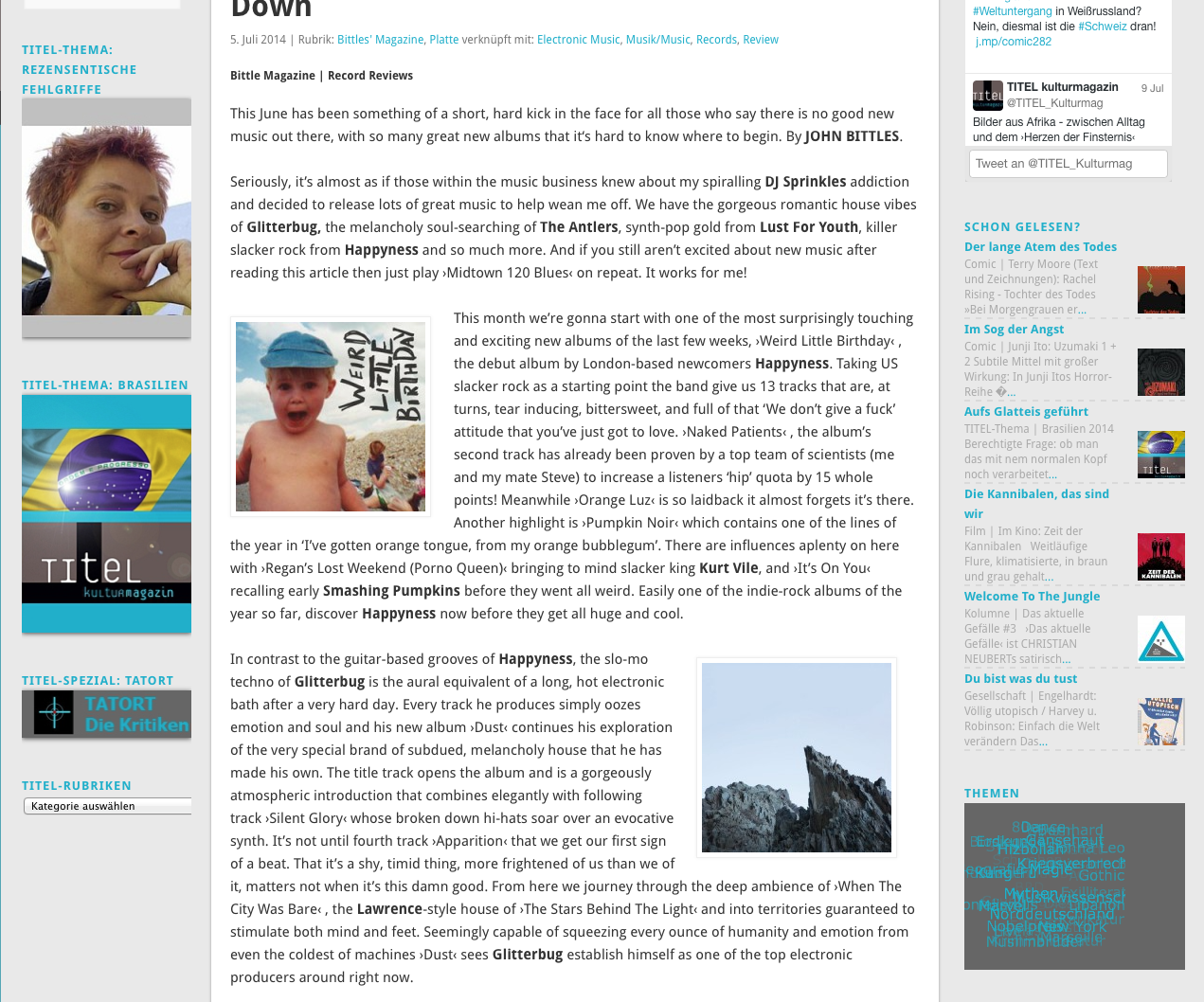
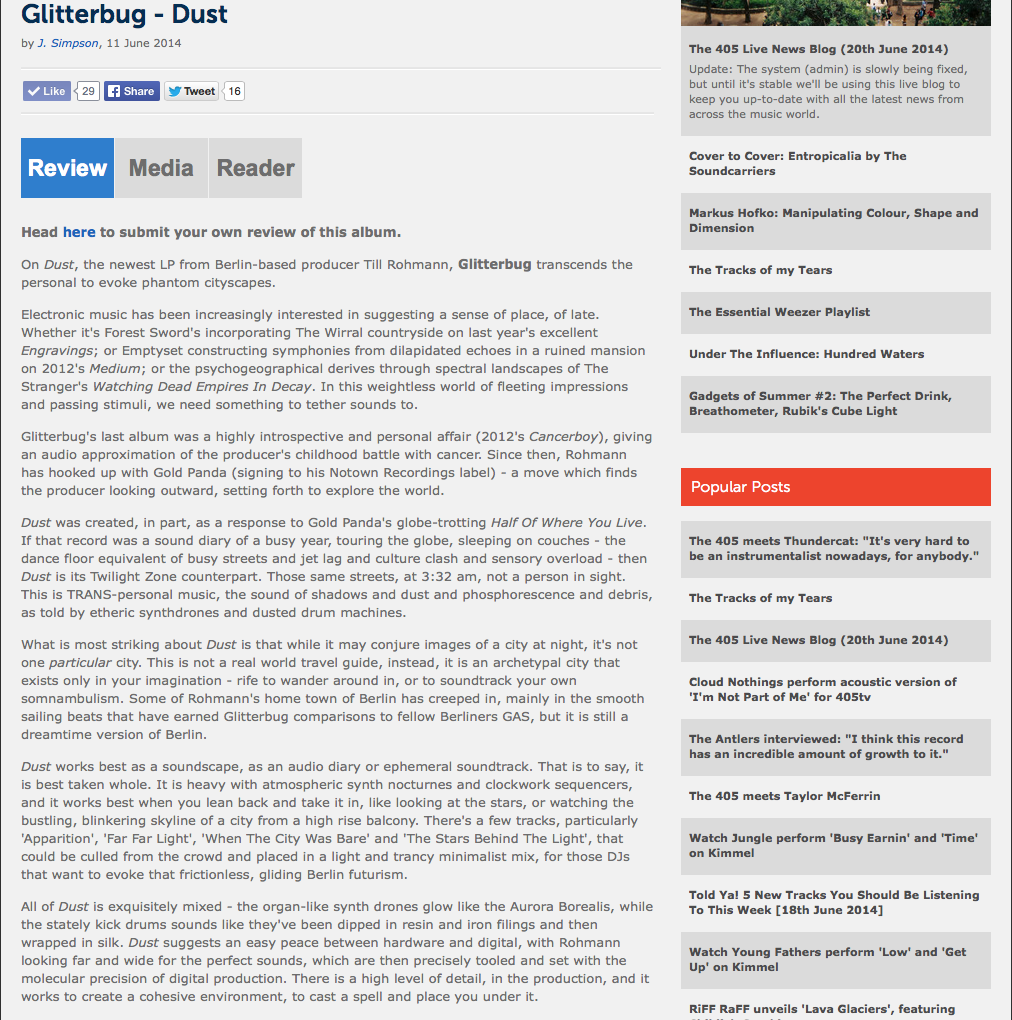
You might ask- what???!?!?? That’s exactly what I thought when a dear friend, Adam Butler (known to many as Vert) sent this to me today. ‘Supershelter’ (released in November 2008) feels so far away… sometimes I forget: it actually does not matter when a record came out, it matters when it is discovered by the listener. So I am happy that good ol’ Supershelter found a late appreciator!

And thank you, dear people from Aquarius Records, for taking so much interest in my music!!

Screen shot 2010-08-28 at 4.57.13 PM

GLITTERBUG “Supershelter” (C Sides Label) cd 16.98
We totally flipped for the new Glitterbug record, Privilege, reviewed a couple lists back, the work of Till Rohmann, a German DJ / producer / artist, whose Glitterbug sound was exactly what we had been hankering for, a glorious blend of processed field recordings, soft pulsing glimmering synthscapes, stripped down minimal techno, abstract kosmische krautdrone and pop ambience, so when we discovered there was another, previous Glitterbug, we knew we had to check it out. And once again, were were not disappointed. Supershelter is another heady blend of Kompakt style skeletal techno, and warm swirling synthy drones, dark ominous rumbles, and ethereal after hours party music, skittery, and stuttery, washed out and hypnotic.

After a gorgeous slow melodic intro, that sounds like it could have been plucked from a Burzum record (at least before the plink plonk piano counterpoint comes in), the next few tracks unfurl the beats, wrapped around playful keyboards, percolating clicks and chirps, some sweetly melancholy melodies, even some soaring faux strings, “The Things I Long To Do” almost sounds like a Bjork backing track. “Oh My Hick!” is another skittery techno, warm liquid ambience hybrid, while “Unforgotten” is a brief stretch of hissy static rumble, leading into “Reference System” a low slung slab of synth wrapped late night shuffle, groovy and subtly funky, which butts right up against the warped and muted “Brontohouse” which does evoke some sort of giant beast, with its muddy thumping rhythm, and warm whirring buzz. The record plays out similarly, flitting from minimal thump and pulse, to woozy washed out drift, and quite a few stops in between.

Imagine a less clinical, more playful Kompakt, this will definitely hit the spot if you’ve been digging any of the recent weirdo electronica from folks like Actress, Pantha Du Prince, Klimek, Vex’d, T++, Thomas Fehlman, Oneohtrix and all the rest…

Crazewire (DE) about ‘Privilege’…

Tuesday, August 17th, 2010

The very friendly people of Crazewire published a late review of ‘Privilege’, very very sweet and very very friendly. Thank you for the warm words!!!

You can find the original article here.

Screen shot 2010-08-17 at 12.14.25 AM

“Die meisten werden diesen Moment kennen. Den Moment, in dem man schlagartig an nichts anderes mehr denken kann als an dieses Gesicht, das einem gerade ein Lächeln zugeworfen hat. Völlig unvermittelt ändert sich plötzlich alles. Je länger man an diesen Moment denkt, desto verschwommener wird das Bild. Waren diese Augen grün, braun? Dieses Lächeln echt? Diese Fragen treiben dich, und im Idealfall sieht man sich ein zweites Mal.

Als ich Glitterbug 2009 völlig erwartungslos im Rahmen der c/o pop im Vorprogramm von Moderat gesehen habe, war das ein solcher Moment. Gekickt von den verträumt zurückhaltenden Beats und den damit komplementären Visuals, verliebt in die sympathische Erscheinung der Beiden hinterm Mischpult. Seitdem möchte mich „Germany’s best kept techno secret“ nicht mehr loslassen. Dennoch, ein Jahr hat es gedauert, bis ich diesen Klang-Moment wieder sah.

Wieder völlig unvermittelt konnte ich Glitterbug in Amsterdam erleben, diesmal mit neuem Album im Gepäck. „Privilege“ ist der Nachfolger vom 2008 veröffentlichten „Supershelter“ und entstand zwischen Tür und Angel. Mastermind hinter dem Projekt ist der Kölner Produzent Till Rohmann, der auf seinen Tourneen und Reisen durch Isreal, Europa, Indien und China in den vergangenen Jahren allerhand Klänge aufgefangen hat und diese in seinem Studio zu epischen Klangkonstrukten verwertet. C.Sides-Kuratoin Ronnie Shendar weiß diese Klänge zu verbildlichen, sodass man sich bei ihren Dou-Live-Shows auf eine Reise quer durch die Welt einlässt, dabei aber stetig auf einer Stelle tanzt. Das 20 Tracks starke Doppelalbum ist bei C.Sides erschienen und nimmt dich mit auf eine Reise abseits der bekannten Pfade.

Seicht und behutsam geht es mit „Lionheart“ über das dahin fließende Wasser durch schattige Wälder, wobei sich die Töne des Klaviers wie Sonnenstrahlen an den Blättern und Ästen vorbei suchen und direkt auf dem Herz landen. Nach den ersten fünf Minuten öffnet man die Augen und stellt fest, dass man doch nur in einer Wohnung mitten in der Stadt hockt, Straßengeräusche durch das offene Fenster huschen. Mit gestärktem Beat wird man in „Swirl“ in unbekanntes Territorium geleitet und weiß nicht, ob der Rhythmus von den Kopfhörern ausgeht, oder es die eigenen Schritte im Gras sind. Man verwechselt die Schönheit der Natur mit der aus den Kopfhörern und weiß nicht, ob die Klänge daneben doch vielleicht der Wind an deinen Ohren ist und das Rauschen der Blätter. So wie man sich live in die Visuals der israelischen Videokünstlerin verlieren kann, verliert man sich bei einem Spaziergang mit „Privilege“ in den Ohren in Raum und Zeit. Nahezu meditativ gelangt man von Track zu Track – oder von Ort zu Ort.

Scheinbar werden hier Momentaufnahmen in einem ganz neuen Format digitalisiert und bleiben auf einer abstrakten Art und Weise für die Ewigkeit erhalten. Einen Einblick bietet das aktuelle Video zu „Calcutta“, das mit minimalistischen Kamaraeinstellungen – ebenfalls produziert von Ronnie Shendar – die Schönheit der Chance einfängt. „After All“ stürzt sich dann zur Abwechslung mit ausgestreckter Faust auf den Hörer und zerrt ihn förmlich auf die Tanzfläche. Nach abwechslungsreichen siebzig Minuten geht es in die zweite Hälfte und Glitterbug wäre nicht Glitterbug, wenn es hier monoton oder gar langweilig zugehen würde und kein Ass im Ärmel stecken würde. Mit „Waves“ geht es nahtlos weiter in der meditativen Momentaufnahme. Hier und da tricky Klangschnippsel die sich mit den aufregenden Beatstrukturen zu einem homogenen, packenden Etwas aufreihen und den Hörer weiter und weiter versinken lassen. Nach den knappen zweieinhalb Stunden weiß man ehrlich gesagt nicht so recht, wie es um einem geschah. Man weiß nur, dass sich die Platte weiter drehen muss.” – Christopher Szwabczynski

Wonderful review from San Francisco!

Saturday, August 7th, 2010

The nice people from Aquarius Records in San Francisco (”established 1970! the store that’s old enough to think it’s funny that we’re selling lots of tapes again”) wrote a very sweet review on their website & newsletter, and I thought I HAVE to share this. Thanks guys!!

Screen shot 2010-08-07 at 10.57.16 AM

“After a bit of a dry spell, in terms of electronic records that had us freaking out, it’s been pretty much nonstop freakouts for the last little while. Pantha Du Prince’s Black Noise record, the reissue of his This Bliss and Diamond Daze albums, all three records minimal and skittery, bleary and chilled out, moody and synthy and drone-y, occasionally pulsing and throbbing, a little groovy, a little pop ambient, a little techno, all wound into an ever evolving world of mysterious and magical electronic sound. Then came Actress, the new record Splazsh, not to mention his earlier Hazyville, again, both dancing on the edges of electronica, pushing the boundaries, skittery minimalism, weird playful collages, looped and hypnotic, chopped and recontextualized vocals, glitch and squelch and ambient shimmer, as well as twisted beats. And that’s not even mentioning other electronica faves like T++, Vex’d, Klimek, Thomas Fehlman, Emeralds, Oneohtrix Point Never, but the reason we mention Actress and Pantha Du Prince, is that the music of Glitterbug seems to exist in a similar sonic continuum, melding washed out dreamlike ambient shimmer, with stripped down minimal post techno, pulsing kosmische krautrock with more earthbound stutter and skitter, and while this is in fact record number two from Glitterbug, aka Till Rohmann, a German DJ / producer / artist, we’re already pretty smitten, as we imagine you might be too, especially if like us, you’ve been listening to the above records as much as we have.

A sprawling double disc, recorded in the studio and on tour, with field recordings from various tour stops incorporated into some of the tracks, sometimes as just another unrecognizable sample, adding rhythm and texture, but other times it’s more obvious, the sounds of life and the world, only further adding energy and emotion to an already organic electronic sound. The record begins with a warm softly pulsing expanse of glimmering synths, a subtle melody, looped and hypnotic, laced with shimmering melodic counterpoint, all hazy and sun dappled and dreamlike, peppered with bits of piano, the perfect blend of abstract kosmische krautdrone and pop ambience. The second track introduces some drums, which sound real, and a bit jazzy, before a more obviously electronic beat joins in, then some thick warbly buzz, some deep low end rumble, some chiming melodies, and we’re off, propulsive and mesmerizing, washed out and softly psychedelic, but super chilled out and warm and luxurious and lush. The next track slips right back into more cosmic synth space bliss, reverbed tones ring out, overlapping, layered, underpinned by awesome intense slabs of low end, more felt than heard, the result is almost like a more stripped down, more electronic Expo 70, spacey and abstract, but with some subtle momentum, less driving and more drifting, but so dreamy and divine, another track that could have filled up the whole rest of the record and we would have been perfectly happy, and there are plenty of tracks like that on these two discs.

And so it goes, for the next two hours, Glitterbug’s sound slipping seamlessly from pulsing minimal skitter, to murky muted throb, to ethereal glimmering drift, to hushed crystalline shimmer, to abstract drone flecked house music, to dark, almost dirge-y Carpenter style synthscapes, more often than not, those various sounds bleeding into one another, overlapping, intertwining, the sounds lush and lustrous, rich and organic, the rhythms spare and skeletal, sometimes delicate, other times dense and dark, but always fantastic and futuristic, blissed out and beautiful.”

Retroblog on Privilege…

Monday, July 26th, 2010

Very nice: Retroblog issued this very sweet review on ‘Privilege’.

You can find the original post, plus some other recommendations, here.
***

Great music to design to: 2010 so far.
“Epic and elegant, this double album from Glitterbug manages to both accommodate fans of melancholic tech house as well as those who’d rather sit and ponder. Many of the more upbeat tracks here are functional for a dancefloor but share the same gloomy overtones worked by contemporaries such as Lawrence, Fairmont and Pantha Du Prince. The LP cuts out a lot of the fat and streamlines the release into a much smaller batch of tracks, but this is perhaps best experienced as the full 20-track double-CD/digital version. In its full running order listeners are treated not only to some slick melancholy tech house tracks but also some interesting diversions like the stark piano exercise of “So Could We,” the quasi-dubstep break of “Parted,” the odd acoustic drum kit of “Waves,” the Eno-esque ambient beauty of “Lionheart” and more. It’s a lot to digest in one go but those who lend their time will not be disappointed.”

Norman Records / Leeds, UK review

Monday, July 26th, 2010

This is a super sweet review and recommendation from the nice people at Norman Records in Leeds, UK. Thanks guys!

You can find the original post here.
Screen shot 2010-07-26 at 10.30.39 AM

“Gosh this is super nice deep, emotionally driven techno. It’s very soulful, warm and inviting and really has me shaking along to the infectious smoky grooves. Certainly folks enjoying Pantha Du Prince will be seduced by ‘Swirl’. A hypnotic late night brain hugger. Mr C once used the term “pretty techno” to describe Carl Craig’s music and I think those words can be applied here. The way the tracks flow and new elements are introduced is great. Even some strange sort of field recording sound and stuff but things never veer from the accessible. Plus the production really is pristine, every sound tweaked and polished with immense attention to detail. I’m very much reminded of classic Artificial Intelligence era headphone techno in terms of how the music takes one on a journey and just invites all sorts of visual imagery into your mind. I liked the last album he did a lot, this is his second and after hearing it I will say that Till Rohmann is a real dark horse and I would hope an artist that gets some recognition for his productions. I’d say followers of everyone from The Black Dog/ART through to early Warp, R&S and deeper Detroit and Cologne styles should really check this out. With 20 tracks in all on the 2CD set, I’d go as far as saying grab the CD over the vinyl. But of course if you like to spin records then the vinyl has plenty of highlights too.”

Unedited interview for MCD France

Wednesday, July 14th, 2010

The article/interview that was published in the MCD magazine earlier this month, is, of course, a shortened version of a very (very!) long interview I gave. Laurent Diouf, the wonderful chief editor of MCD, and I decided that it would be a waste to just trash the whole thing, and thus we decided to publish it here.

The full french article can be read here, in a more reader friendly PDF: MCD 59 – Glitterbug Interview

And here is the full interview (be prepared for a long read):

01_ first, can you describe your background, influences, and also why you choose the name “glitterbug”…?
My love for electronic music, and thus my first influences and exposure to it, stem from the late 80s rave and acid scene, at least when speaking about electronic dance music. I was a very vivid party goer already in my early youth in 1986/87, and was also making music at that time (my instruments then were the flute and drums, but I was mostly playing in jazz bands and the school big band). Back then I didn’t have these different musical worlds connected, nor did I realize they could even meet. I was sort of living in three different musical worlds that never ever really overlapped: I had my band/jazz life as a very young musician, my love for acid music and raves, and in addition was listening to and admiring totally different music: 80s wave, experimental music, contemporary composition, experimental indie rock, things like that, but always with a focus on the more touching, emotional and melancholic things.
After the late 80s and three years of heavy raving, my interest in electronic dance music became smaller until it was sparked again in 1994 during a performance by not-so-famous-yet Jeff Mills, who gave a show in a legendary Cologne Club called ‘42’- in front of maybe 40 people… this is where my ongoing and deep love for Techno comes from. This was also the point where I bought my first two Technics turntables and started buying DJ vinyl. Two years later, in 1996, I was DJing at my first parties. During the 90s, the scene here wasn’t yet so ‘specialized’ or narrow: the experimental-music people went to techno parties, there were “chill out rooms” in which abstract and eclectic music was played, and everybody was hanging out with everybody. This very special breeding ground in those years, with an approach that “anything goes”, was very important for my later baby steps into producing music myself.
In the early 90s I also started basic freelance work for public radio stations in Germany, mostly in the field of ‘sound design’ (well, the term didn’t exist back then) for radio plays, later working on experimental radio plays of my own, which eventually led to my first equipment purchases in the mid/late 90’s. The stuff I was working on back then was mostly more abstract and very experimental, toying around with cheap broken equipment (which was the only stuff that I could afford).
This is, btw, one of the sources for my artist name: I had a really old half broken EMU EMAX sampler during those years, and it would never do what it was supposed to do, but rather spit out random, strange and really beautiful sounds, it had a very glittery bug (until it finally broke down completely). I also was a huge Derek Jarman fan, and he came out with this wonderful, touching and very personal movie called “Glitterbug”, with music by Brian Eno and Jah Wobble. I loved the approach, I loved Derek Jarman, I loved this wonderful record by Brian Eno (which is called ‘Spinner’), and due to the fact that I started discovering Detroit techno in 1994, ‘Glitterbug’ became my name for my DJ alter ego. So, it comes from a wonderful experimental movie and from the acknowledgement that wonderful things can (but do not have to) happen if stuff goes wrong…

02_ how did you planed and composed your new album, “privilege” ? can we say that it is less “dub”, more ambient or introspective than “supershelter” ?
Well, the plan changed over the course of time. All together I worked for something like a year on this album. At first, I wanted to make a totally abstract ambient album, and I started drafting first tracks, but at the same I was working on more techno (and/or house) tracks. After a couple of months, I started to listen to the tracks that I made and realized that my concept didn’t work at all: the tracks, regardless of their ‘genre’, were all related to one another, were following a similar mood and atmosphere, and so I realized that it’s pointless to try to separate them. I already had a lot of material, which could have been enough for an album, but I felt it wasn’t quite there.
So the second idea was to continue working, and to try to take my creative process out of the studio and to continue working more “on the road”, knowing that I would be touring a lot. Since currently I mostly perform live, using a lot of outboard equipment, I had a very basic studio on me all the time… I had a 2 months long “world” tour in 2009, which brought me to places like China, India, Norway, Poland to name just a few. Some of the tracks on the album were drafted during this tour and have quite a few field recordings from those places in them.
So the second approach was to do a double CD album with one studio part and one “on the road” part. This concept I also threw overboard once I started to seriously compile the album. The tracks were not only related, they also told a stringent story regardless of the period in which they were made; so I compiled them accordingly, with my heart and intuition rather than by categorizing them according to when and where I made them.
Speaking of differences and similarities to ‘Supershelter’ and the general musical direction I took with ‘Privilege’, I can say that it is much more serious in many ways, less cheerful, more restrained and certainly moodier than ‘Supershelter’. But I disagree that it is more “Ambient” then pervious things I have done, since there are quite a few tracks on there which speak a very clear, direct and loud club language (well, we’re still speaking Glitterbug here, right?). The effect of feeling that ‘Privilege’ is more ambient than its predecessor comes mostly from the fact that it is long and that I finally had the chance to span my ideas and tracks over such a long playtime. Nothing is rushed on this album, and I had the freedom to leave plenty 8 or 9 minute long tracks unshortened… This was an amazing new artistic freedom that I could achieve in this project.
‘Privilege’ also is definitely much more introspective, that’s true. It’s quite a pensive album, which also reflects on the circumstances of its own existence. During my last international tour I played in places which confronted me with the obscene wealth of opportunities I have in life, and the fact that I can choose to be an artist, a musician, composer or producer (or whatever you might call what I do) is pretty unbelievable. I played in places like Mumbai/ India, where the level of poverty is simply unimaginable. To be invited to Mumbai to play in a fancy club, driving through never-ending slums on the way from the hotel to the venue with equipment in the trunk that is worth enough to feed a small town in India for months is something that left a huge dent in my reception of reality. So yes, ‘Privilege’ is quite a serious album, but also has very hopeful moments. It’s charting new territories in a way; for me, it is like my approach to find new worlds, places and habitats in and through music.

03_ generally speaking, how do you define dub music and more especially how do you describe the connection between dub and minimal-techno/ambient, and also the evolution of this connection/emulation ?
I guess this would be better answered by a special edition of MCD, analyzing various streams and developments in electronic music today! (If you do that special 200 page edition, could you please also publish it in English??!?!!??) ;-)
But seriously: this is a tough question for me to answer. My approach to music and also to making music is different from any analytical approach. I don’t analyze what I do categorically, as I have a very emotional access to my art and music. The same with my record collection spanning through quite a few thousand vinyls (and a considerable amount of CDs and hard drives): it’s all not so much filed under musical categories, but rather moods and atmospheres. This is also how I put together my DJ materials for sets: less by a certain musical category, but more by the feel of the tracks.

04_ as the previous, “privilege” is available on c.sides. please, can you tell us about this structure ? if i well understand, you co-run s.sides with ronni shendar. so this “plateform for electronic music and new media art” is also a kind of arc / bridge between israel (+ palestine) and german ’s projects / musicians, artists, etc. ?
c.sides is a lot of things, and all of them carry a very personal signature. I started it (and continued it until today) together with Ronni Shendar, an Israeli photographer and video artist. We met in early 2003 in a German-Israeli artist exchange, and shortly after I came to Israel for my first DJ gigs. The electronic music scene there was under total isolation back then (due to the 2nd Intifada which was at its peak in those days), and we started a process of bringing more international artists, mainly (but not only) from Germany, to Israel and also inviting artists to Germany.
From the beginning, the informal exchange was solely based on mutual interest, on reflecting the different backgrounds, histories, realities and contexts. Obviously, confronting a lot of issues of the 3rd generation after the Holocaust for both the German and the Israeli side, and the realities of the Occupation, the vast social complexities in Israel, questions of art production in periods of war and unrest, and the different socio-economic-political issues both sides had to confront.
Before we even came up with the idea of establishing a more of a formal platform for exchange, something like 15-20 artists from both countries went through these different visits- and Ronni and I realized that there is so much mutual interest that we need to create something bigger, that allows for more people to join.
c.sides is a totally non-commercial platform, and was built from the beginning (2004) as a mixture between an electronic music and media arts festival and sort of an educational program for participating artists.
All artists that we invited over the years came for at least a week to participate in educational tours, lectures and exchanges that we organized for them. We wanted to make sure they can grasp as many perspectives as possible of a complicated place with intertwined struggles. The goal is to send everybody back home with more questions than they came with, and to portray the situation in the Middle East as complex and multi layered as it is for the many different communities that live there.
We are a political festival- but without a political agenda… we oppose easy answers and put our bet on discussing complexities of gray zones in which people actually live and confront rather than simplistic black/white thinking. Besides our major productions in Israel (in the beginning in Jerusalem, these days in Tel Aviv), we have also had various projects and show cases in Europe, and have more cooking up for the future.
c.sides as a festival also had the horrible disadvantage of taking place twice during a war: once in 2006 directly after the 2nd Lebanon war, and the 2nd time during the war in Gaza in 2009. Having to face such horrible atrocities which take place only 200km away from the festival grounds, certainly has a huge impact on a project like ours, and having to ask yourself several times a day if it makes sense to produce and carry out a festival like ours during such times and to also discuss these issues with fellow artists participating in the production automatically leads to different questions and issues than, let’s say, a beer shortage in a club in Ibiza…
To curate and produce a festival like ours is a very challenging subject matter. The current situation in Israel, especially the news of today with the stormed flotilla that was supposed to bring humanitarian aid to Gaza, always pushes us over the cliff when we try to think of how to continue the c.sides festival. But as grief as the situation is, and as horrible and awful, we are still trying to organize something that raises awareness, that questions the status quo of art production, and that widens the perceptional horizons of artists and audiences alike.
The c.sides label exists since 2006, but is just as amorphous of a project as the festival. It became the major platform for my music, but that wasn’t really the plan in the beginning. From the label’s mission statement:
“The ‘c.sides label’ is supposed to be a label with music meant to bring heart and beauty back to electronic dance music and to give space to the more experimental and content oriented sides of club electronics. We want to break hearts on the dance floors worldwide and make our audience shed tears and have twinkley smiles. We want to add an exciting new flow to the crowded label universe – we want to prove that bulky, sentimental, heart breaking and brain wrenching formats can work quite well to rock the floor.”
I guess that describes quite well what we are trying to do. The description would also work for the festival I think…

05_ what about the c.sides festival ? will you do an edition this year (i don’t see infos) ? or in 2011 ? or is it in stand by ?
Well, since c.sides is ran by exactly 2 people (and that is, surprise surprise, Ronni Shendar and me), we can decide on every aspect of what c.sides is and where c.sides is heading. We started the festival as an annual project, but realized already in 2006 that this would not leave any room to breathe for any of our other projects and our individual artistic work.
Since there never was a plan to become festival directors (and nor do we enjoy producing something so crazy as a festival), but rather having a festival that developed out of a need for something like that (there was no such thing in Israel when we started, and by now we are by far the largest festival of its kind in Israel), we try to balance our time between the festival and our other projects, and thus it’s a loosely bi-annual project. We are cooking up something for late 2011, but it’s way too early to speak about it.
In addition, we do have all the issues that most other festivals internationally are facing these days: lack of funding. The financial crisis hit arts and culture hard, and our festival is sadly no exception being a non-commercial initiative. We try to create something that confronts the context it takes place in, and Israel is a fast changing place, currently with a very right-winged government. This of course has a great effect on our production, specifically making it more and more difficult (or rather virtually impossible) to work with Palestinians in the West Bank or other cooperations we have tried with artists from Egypt or Lebanon. We sadly have to keep the two paths separately for now.

06_ generally speaking, how do you consider the (rare) musical intitiatives relative to some socio/political situations and/or events ? i mean, do you think that the electronic scene has a socio-political consciousness ? and do you think it could be really efficient ?
Well, if I wouldn’t believe in some possible artistic contribution to make the world a better place, I probably wouldn’t co-run a festival like c.sides. I talked about a few of these things above.
Generally speaking, I think that the electronic music scene has to reclaim some of its roots. Especially playing a lot of festivals and club events as an artist myself, I meet a lot of colleagues that seem to have forgotten that we once were part of a movement, of a culture, and that there is (and should be!) more to what we do than just the party itself, the Champaign brand the promoter chooses, and the quality of drugs available. We live in a very very VERY privileged situation, and well, yes, I do think that this comes with certain obligations.
I am not a friend of over exposing content where there is none. I am also not a big fan of hollow slogans and simple answers. But in my reception, electronic music should always carry the liberating elements that House Music was born with, and for me, my artistic process of creating music always also has to do with creating parallel universes, additional habitats, and somewhat of trying to create a better world. In tiny pieces, and tiny contributions, but at least we should try to make our privileges as artist beneficial for others too.

07_ by the way, can you tell us about the electronic music scene in israel — we only know the trance-goa movement but (almost) not the minimal and experimental scene — and also in cologne nowadays ?
Uf! You want me to write a book?? ;-)
I am and have been only present in small parts of the electronic music scene in Israel, and it has been changing a lot in the past few years.
In a nutshell, when I first came to Israel in 2003, there was a very small, dedicated (and isolated) experimental electronica scene in Jerusalem, and a very commercial house scene in Tel Aviv. The techno that was played was of the tough fast industrial kind, and when I first played in Israel, the strange, slow, melodic and more minimal music that I played during peak time in clubs was totally unknown, and people were very confused by it in the beginning.
We as c.sides take some pride in helping establish a certain music in Clubs in Israel, but that would not work if there would have not been people around us picking up on the idea fast and walking this long path with us. Our dear friends from Pacotek ( www.pacotek.com ) were there from the very first moment, and hosted my first DJ gig in Israel, even before the collective had this name. There was a very funny moment which changed a whole lot of things: a friend and incredibly talented DJ who was back then also part of the Pacotek universe, Dani Zherzhevski, was playing at a bar in Jerusalem, and he had the pitch (of already super fast techno) at plus 8, and I asked him if I can do something: he said yes, and I pulled the pitch down to minus 8, which left him in awe since he never even tried to do something like that. From then on, he started to play his stuff slow and gentle…
Today Tel Aviv hosts two wonderful clubs for techno, house and wider scopes of electronic dance music (The Block and Barzilay), in addition to smaller independent lines that take place in obscure and changing locations and aside to countless mainstream clubs. The scene has developed and grown quickly! By now every weekend there is at least one leading international act playing at one of these clubs, with a strong connection to Berlin, New York and Detroit.
There are definitely more and more Israelis producing music and also part of the international techno/house scene.

08_ relative to your live-mixes / dj-sets, are you still playing with 3 turntables or/and are you also using digital sources ?
My live performances are based on a hybrid setup with analogue gear and synthesizers, and a computer running the same software as most other computers you find on stage these days, with a vast amount of controllers. I do not touch the computer during the show, but use my controller setup to navigate.
When I DJ, I am always asking for three turntables, but sadly most club setups don’t have space for a third turntable in the DJ booth these days. I have been using a hybrid between digital vinyl control systems (in the beginning, I used a MAX/MSP patch for vinyl control called Ms. Pinky, today it’s a product of one of the key players in vinyl controlled playback, due to reliability issues) together with vinyl for something like 9 years now, and I enjoy the opportunities I have as a DJ in a setup like that.

09_ you did also some radio shows and/or mix for web-radio (if i’m not wrong). i think radio-shows are may be a sound-universe — a “blind” universe because we don’t see the audience — between live-mix and studio work… so, how do you plan/manage your selection for radio ?
Preparing DJ sets for podcasts or for radio shows is allowing for totally different approaches than a DJ set in club. I can allow myself to be less of an entertainer, and can play more with atmosphere. I also have to bear in mind that radio shows are often more of an audible backdrop more than something that is listened to consciously, so try to create something that is emotionally dense yet not too challenging on the ear.
My music has often been described as “visual club music”, and I am quite happy with that category. I try to create music that has a certain depth to it, music that takes the listener someplace. I work with a lot of imagination, and creating music in the studio is always a very lonely and isolated task. So standing in a radio studio and playing and mixing music for unknown people in unknown situations out there, to be present in their homes and daily life through the medium of radio is something very magical to me.

10_ i saw that you’re also doing performances av (with ronni shendar), installations, b.o./soundtracks, etc. and you also work as curator. so, a few sentences about your “side” projects ?
I am involved in many different things, my club alter ego Glitterbug is only one of them. I am currently working on an abstract score for a more philosophical documentary movie about jails, have been doing collaborations with other visual artists for installations, have been active as a curator for more than a decade… I don’t necessarily do these things all the time, but if an interesting project pops up, I am always happy to take the challenge.
Ronni (Shendar) and I have been working together since almost 8 years now, and for us it was just a logical step from curating the festival which deals both with audible and visual digital art, and creating platforms and structures for other artists to translate these philosophies into our own project and art forms – an audio-visual live performance.
Ronni adds a totally new perspective to my live performance. She works only with her own footage, materials and photographs that she manipulates very minimalistically through various programs. She creates a very cinematic language that corresponds with my visual music and that unfolds layers, textures and landscapes of her concurrent world. We try to create a dialogue between our ‘worlds’, it’s really a very joint performance, in some parts inseparable.
From the press sheet regarding our joint show: “In creating their new live performance, Shendar followed on the album’s base concepts and themes, drawing upon to explore its desolate landscapes, its uninhibited territories and blurry distant dolor, a further interpretation to her photographs that comprise the album’s artwork.
Their new live performance takes the concept of audio-visual shows to a whole different level. Every bit and piece of it is built and customized from scratch and both the audio and the visual component are linked to one another, creating an unforgettably intense, wholesome experience for the audience that is unmatched. Their previous show, that left promoters and audiences internationally in awe, already pushed the border of what can be done in club and festival contexts. Their new show takes this approach not only one step, but is a whole new evolutionary step in their work, incorporating also all their live experience they could gain in their successful year of 2009.”

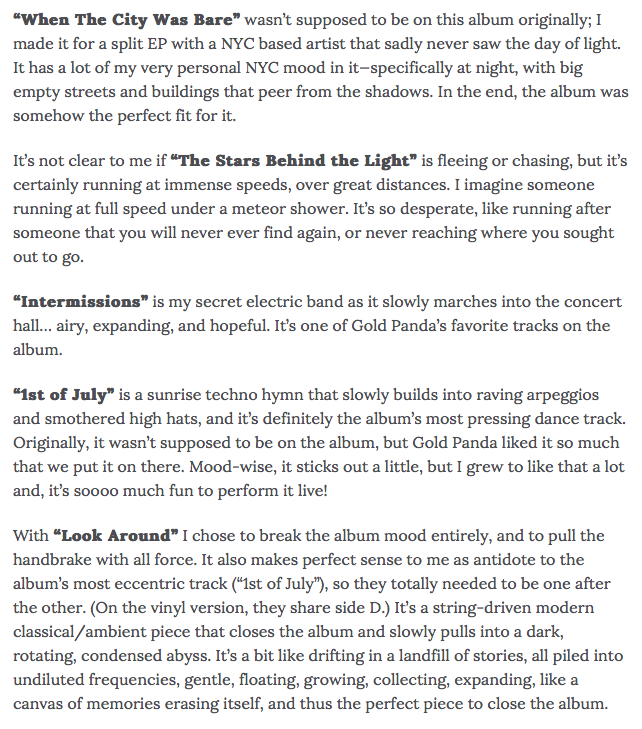
Review in Pitchfork!

Thursday, July 8th, 2010

Hmm, a bit of a strange review- but hey, it’s in Pitchfork! ;-)

You can find the original article here.

Screen shot 2010-07-08 at 4.43.38 PM

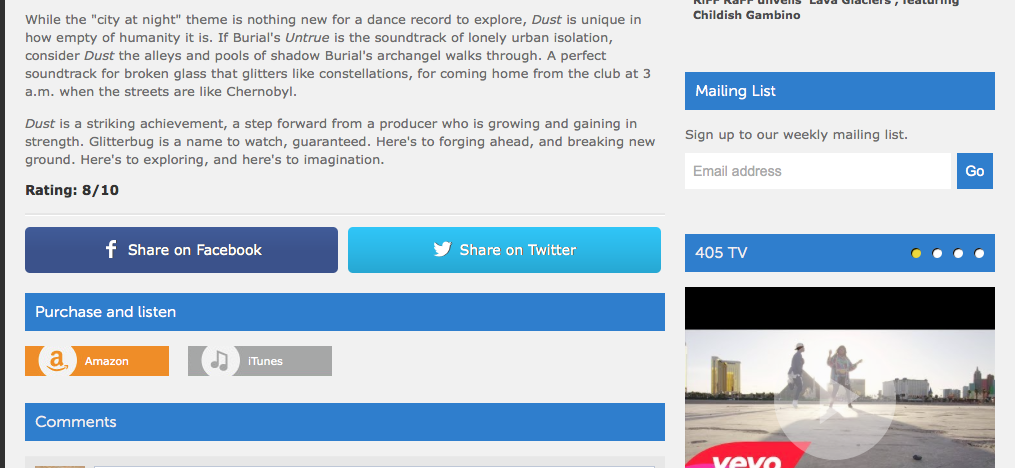
For a guy called Glitterbug, this Cologne-based producer doesn’t seem to throw very much away. His second album, Privilege, is a double LP with 20 tracks that mostly hover in the six- to eight-minute range. That’s well over two hours of enigmatic techno to digest, and it can’t even be called diverse, at least on the surface. Glitterbug’s unwavering commitment to icy pulses, tidy minimal beats, and unfiltered repetitions makes the songs flow by without much fanfare. Dynamic shifts are used sparingly, and handled with precision. Despite all the steely synth arpeggios and clockwork drums, Privilege often feels more like ambient music than techno, settling comfortably between foreground and background, scratching the same itch as Gas and the Sight Below.

Brock Van Wey’s White Clouds Drift On and On is a great example of a record that was both monolithic and advantageously overstuffed, pushing through some tedium in order to weave you fully into its unique world. Glitterbug’s clipped palpitations wear thin more quickly, but his extended durations do wind up cultivating deep immersion. More editing here might have done more harm than good. It’s not like there are a few heaters hidden in a bunch of filler, although the tracks with naturalistic pianos (”So Could We”, “Lionheart”, “Transitions”) are especially wonderful, and I wish there were more of them. Even though some tracks, taken individually, just go on for too long, together they accumulate an oceanic breadth and depth that makes Privilege as a whole feel more substantial than its parts.

Glitterbug’s tracks are least interesting when they’re most purely techno, although he has a strong handle on fundamentals. “Cornered”, for example, ratchets up from arpeggio to house bass to snares to chimes, all neat as a pin, and represents the album at its most functional and sterile. The music gets more interesting as it mingles with carefully captured organic sounds and with other genres, like IDM, dub, modern classical and concrete music. Usually, a hint of mystery is all it takes: “Blast” would be feel pretty flat if not for the bit of resonance fluttering anxiously in the background.

Glitterbug recorded parts of this album on a global tour that encompassed the Arctic Circle and China, and a map of the journey is hidden in the album by way of field recordings, from the extremely wet-sounding water on “Wide & Near” to the mind-gnawing whispers on “Slurred Thinking”. You get a sense of all kinds of secret codes working beneath the hood, and these moments of near-intelligibility ease us through the long haul. We need such things to hold onto amid these almost featureless waves. Why bother with fills and rolls when one kick and one snare will get the point across? Glitterbug seems to wonder. This essentialist mindset reins everything into an ongoing pulse with no margin for error: It can be hypnotic or monotonous, but nowhere in between.

— Brian Howe, July 8, 2010

Feature and interview in the French mag MCD

Thursday, July 8th, 2010

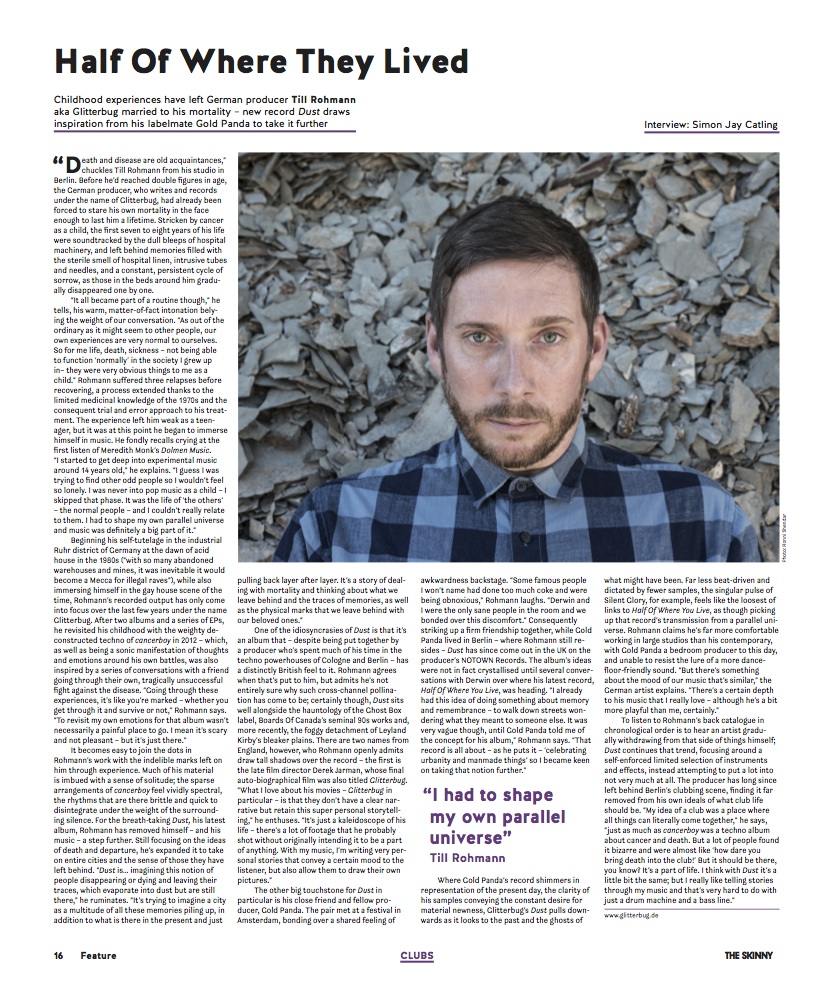
The dear people at MCD in France just published a long article and interview in the July/August issue…

You can find the online excerpt of the article here.

mcd59_p08-09

DE DEREK JARMAN À LA TECHNO MINIMALISTE…

De son vrai nom Till Rohmann, Glitterbug vient de sortir un double-album mélodieux aux ramifications dub et ambient (cf. MCD #58). Basé à Cologne, Glitterbug partage aussi son temps en Israël où il est à l’origine du festival c.sides. Un véritable défi que nous raconte ce jeune homme, ouvert au monde et sensible à la tragédie humaine…

Tu es musicien et DJ, mais tu fais également des performances audio-visuelles (en compagnie de Ronni Shendar), des installations, des bandes-son pour des films et tu travailles aussi comme curateur…
Je suis impliqué dans de nombreux projets, Glitterbug n’étant que l’un d’entre eux. Actuellement, je travaille sur la partition abstraite d’un documentaire assez philosophique sur les prisons. J’ai effectivement collaboré avec des artistes visuels sur des installations. Et je suis curateur depuis plus d’une décennie… Je ne fais pas nécessairement tout cela en même temps. Mais s’il y a un projet intéressant qui se présente, je suis toujours content de relever le défi.
Ronni Shendar est une photographe et artiste visuelle israélienne. Nous travaillons ensemble depuis 8 ans maintenant… Elle a apporté une perspective totalement nouvelle à mes lives. Ronni travaille uniquement à partir de ses propres photographies, films et matériels, qu’elle modifie de façon très minimaliste à travers de nombreux logiciels. Elle crée un langage très cinématique, qui se déploie au travers de textures, de trames et de paysages en correspondance avec ma musique. Nous essayons d’établir ainsi un dialogue entre nos “mondes” respectifs.

Ton nouvel album, Privilege est moins “dub”, plus ambient et introspectif que le précédent…
J’ai travaillé environ une année sur cet album. Et au fur et à mesure, le projet a évolué. En premier lieu, je voulais réaliser un album ambient qui soit complètement abstrait. J’ai commencé à esquisser les premiers morceaux, mais en même temps je travaillais aussi sur des tracks plus techno et/ou house. Au bout de quelques mois, j’ai réalisé que cela ne fonctionnait pas par rapport au concept initial… J’avais suffisamment de matériel pour réaliser un album, mais je n’en étais pas satisfait.
En 2009, je suis parti pendant deux mois, dans un “world tour” qui m’a emmené notamment en Chine, en Inde, en Norvège et en Pologne… Et j’ai continué de travailler “sur la route”. Certains morceaux ont donc été composés durant cette tournée et quelques-uns incorporent des field-recordings captés sur place.
Comparé à Supershelter, je dirai que c’est à bien des égards plus sérieux, moins souriant, plus mesuré et certainement aussi plus lunatique. Mais je ne suis pas d’accord pour dire que c’est plus “ambient”, d’autant qu’il y a quelques titres qui s’adressent directement au dancefloor.
L’impression que Privilege est plus ambient que son prédécesseur provient principalement de sa durée. Il n’y a rien de précipité sur cet album, et j’ai pris la liberté de laisser les morceaux s’étirer sur 8 ou 9 minutes… C’est cette liberté artistique qui m’a permis d’achever ce projet.
Mais Privilege est en effet beaucoup plus introspectif. C’est un album qui reflète mes préoccupations par rapport aux circonstances où il a été composé. Durant cette tournée internationale, j’ai joué dans des endroits qui m’ont révélé la chance, presque obscène, que j’ai d’être artiste… J’ai joué dans des pays comme l’Inde où le niveau de pauvreté est tout simplement inimaginable. J’ai été invité à jouer dans un super club à Bombay. Le fait de regagner mon hôtel en slalomant à travers les taudis sur le chemin du retour avec un équipement dont le prix suffirait à faire vivre pendant des mois une petite ville, en Inde, m’a profondément marqué. Cela a changé ma perception de la réalité… Donc, oui, Privilege est un album un peu plus sérieux, mais aussi avec des moments d’espérance, de bonheur.

Comme Supershelter, Privilege est disponible sur c.sides…
Le label c.sides existe depuis 2006. Mais c’est juste un projet annexe au festival. C’est devenu la structure principale pour éditer ma musique, mais ce n’était pas le but initial. Dans les statuts, nous avions précisé que c.sides est un label dont l’objectif est de redonner âme et splendeur à la dance music, tout en offrant également un espace aux approches plus expérimentales. Nous voulons prouver que l’émotionnel et le cérébral peuvent fonctionner ensemble
[...]
propos recueillis par Laurent Diouf

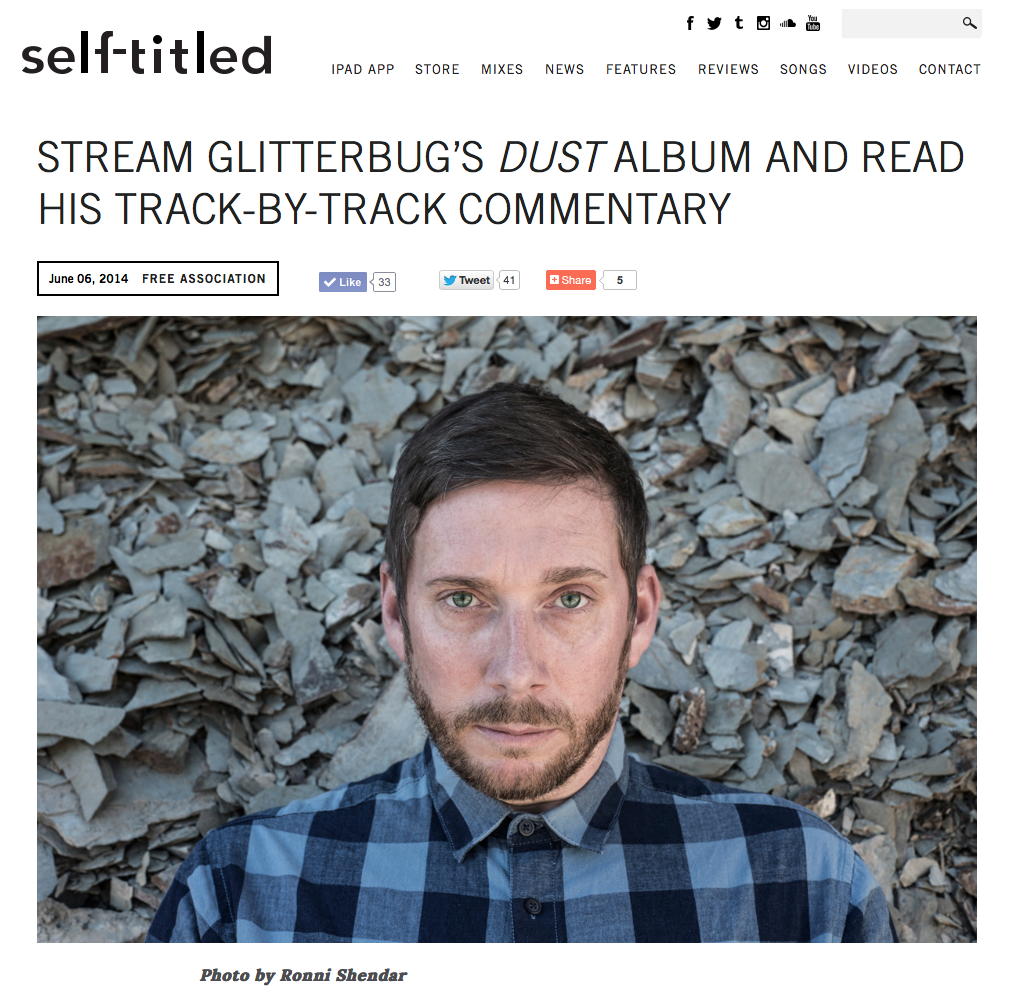
Free compilation, free Glitterbug track!

Wednesday, June 16th, 2010

The c/o pop Festival is approaching, and one of the tracks from my current album, ‘Float’, was picked for this year’s compilation. By the way- we will perform on Thursday, the 24th of June, at the famous Stadtgarten venue. More info on our show in another post…

More on the compilation here, and the track list please find bellow.

Screen shot 2010-06-16 at 8.49.43 PM

“Included on this lovely package you will find 13 tracks by artists performing on the festival, including some of our favourite acts of the past few months, like Aufgang, Tiefschwarz, Chloé, Glitterbug, and Applescal plus our popular stop motion videos.”

Ray Okpara – Vocal Experience
Munk remixed by Mercury – La Musica (Mercury Remix)
Walls remixed by Banjo Or Freakout – Hang Four (Banjo Or Freakout Remix)
Von Spar – trOOps
Tiefschwarz – Home (Edit)
Applescal – Black Spirals
Aufgang – Barock (Edit)
Brandt Brauer Frick – Button
Glitterbug – Float
Chloé – Distant (Radio Edit)
Thomas Schaeben & Schad Privat remixed by Coma – Body Hotel (Coma Remix)
Telonius – Hit Me (Original Mix)
Tolouse Low Trax – Vai Vai
Schlachthofbronx – Arschboss (Köln Version)
c/o pop – c/o pop 2010 – Trailer #1
c/o pop – c/o pop 2010 – Trailer #2

French Mag ‘Soul Kitchen’ about ‘Privilege’

Wednesday, June 16th, 2010

Such a wonderful and loving review I got from the dear people at Soul Kitchen. A few assumed facts are wrong… like, I never went to music academy. Not sure if that’s a good or bad thing…

You can find the original article here.

Screen shot 2010-06-16 at 10.51.11 AM

S’il y a bien une chose pour laquelle nous devrions être envieux envers nos voisins d’outre-Rhin c’est bien leur propension à avoir embrassé dès le début la techno avec un axe Berlin-Detroit dont les liens ne se sont jamais défaits. A l’heure où en France, les journaleux en étaient encore à se demander comment appréhender cette musique, les Allemands ouvraient des clubs sur les ruines de l’ex-empire soviétique, défilaient dans les rues (Love Parade) et publiaient des journaux alors que nous n’avions qu’un fanzine à leur opposer…

Glitterbug
Cette avance prise par nos cousins germains aboutit à la situation actuelle, alors qu’en France de jeunes talents rament pour publier leur musique, chaque mois que ce soit à Cologne, Hambourg, Berlin ou Francfort des dizaines de nouveaux artistes naissent ou voient leurs créativités reconnues. C’est le cas de Till Rohman dont les premiers disques sont sortis en 2008, et il publie carrément un double album, histoire de bien enfoncer le clou. La musique de Glitterbug prend son temps pour captiver son auditoire. Ici tout est calme, apaisant, lisse diront certains pourtant « Privilege » transporte son monde pendant plus de deux heures pour un long voyage qui vous laissera d’une humeur rêveuse et vagabonde. Pour les connaisseurs, la musique de Glitterbug emprunte un axe Sheffield (Artificial Intelligence de Warp) – Windsor (+8) tout en étant profondément actuelle. Ne connaissant pas la biographie de Till Rohman, je suppose que ses fonds de culotte ont du pas mal s’user sur les bancs des écoles de musique de la région de Cologne avant de rencontrer la house et d’en tomber amoureux tant on ressent dans sa musique une profonde érudition, un respect quasi religieux de la dance-music dans toute sa noblesse ainsi qu’une volonté de transcender les genres pour aboutir à ce double album qui comporte bien deux faces de la personnalité de son auteur.
Glitterbug est sans aucun doute un peu décalé dans la scène électronique teutonne qui a quelquefois des allures de rouleau compresseur et ses dj sets ne doivent réunir que des passionnés. Je rêve d’un club en France qui programmerait des artistes comme Glitterbug et qui pourrait réunir des amoureux de musique mais bon, je rêve…

A noter que Glitterbug se produira dans le cadre de l’excellent festival c/o pop à Cologne le même soir (24 juin) que Chloé, ce n’est sans doute pas un hasard…